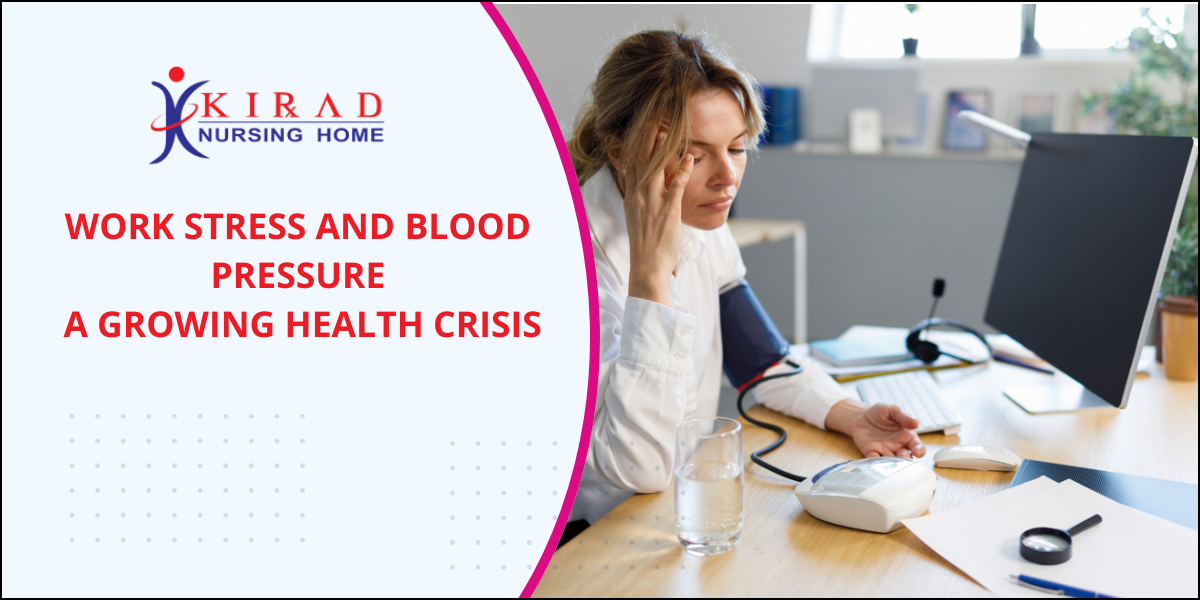
You survived another brutal Monday – back-to-back meetings, an angry client call, and a deadline that moved up by 24 hours. Your shoulders are knotted. Your jaw is tight. But here’s what you probably didn’t notice: your blood pressure quietly spiked – again. And if this is your everyday reality, your heart is silently paying a price you can’t see.
Work stress and blood pressure are more connected than most people realize. In fact, this connection is becoming one of the most urgent health concerns of our time – not just globally, but right here in India, where long working hours and job pressure have become a badge of honor.
The Alarming Link Between Work Stress and High Blood Pressure
The numbers are hard to ignore. The World Health Organization estimates that 1.28 billion adults worldwide live with hypertension. Studies show that people in high-pressure desk jobs face a 14–17% greater risk of developing high blood pressure from work compared to those in lower-stress roles.
In urban India – especially in cities like Pune, Mumbai, and Bengaluru – the situation is worsening. IT professionals, corporate managers, and business owners are being diagnosed with stress-induced hypertension at younger ages than ever before. Many of them are in their 30s.
The scariest part? Most of them feel completely fine – until they don’t.
What Happens Inside Your Body When Work Stress Hits
When your boss drops a last-minute crisis in your lap, your brain immediately triggers a survival response. Your adrenal glands flood your system with cortisol and adrenaline – the same hormones your ancestors used to run from predators.
These hormones cause your heart to beat faster and your blood vessels to tighten. That pushes your blood pressure up – fast. Under normal circumstances, once the threat passes, everything settles back down.
But here’s the problem: modern work stress never really passes. The emails keep coming. The deadlines stack up. Your body stays in “danger mode” day after day.
Over time, this constant activation damages the inner lining of your arteries, forces your heart to work harder than it should, and sets the stage for chronic hypertension – even when you’re technically sitting still and doing nothing.
5 Hidden Ways Your Job Is Quietly Raising Your Blood Pressure
- Working more than 10 hours a day – studies link long hours directly to higher cardiovascular risk
- Poor or broken sleep – stress keeps cortisol elevated overnight, preventing your BP from dropping as it naturally should
- No real breaks during the day – your nervous system never gets a chance to reset
- Eating at your desk – rushed, processed meals spike blood sugar and sodium intake
- Job insecurity and lack of control – feeling powerless at work is one of the strongest predictors of occupational stress hypertension
Warning Signs You Must Never Ignore
High blood pressure from work stress is called a silent killer for a reason. Many people feel nothing – no dramatic symptoms, no obvious alarm bells. By the time something noticeable happens, damage has already been done.
That said, here are 7 signs that deserve immediate attention:
- Frequent morning headaches – especially at the back of the head
- Heart pounding or fluttering for no clear reason
- Tightness or discomfort in the chest
- Blurred vision or spots
- Feeling exhausted even after a full night’s sleep
- Sudden nosebleeds with no injury
- Mounting anxiety that doesn’t have an obvious cause
If you’re experiencing any of these regularly – especially alongside a stressful job – get your blood pressure checked. Today, not next week.
Who Is Most at Risk?
Not all jobs carry the same burden. Research consistently shows that high-demand, low-control jobs create the most dangerous stress profile. You have enormous pressure but very little say in how things get done. That combination is particularly damaging to the cardiovascular system.
Night-shift workers, emergency responders, healthcare workers, and people managing teams without adequate support all fall into this high-risk category.
And before you think remote work is a safe escape – it often isn’t. Working from home has introduced a new kind of pressure: no clear boundary between work and rest, constant digital availability, and the loneliness of isolation. Many remote workers report feeling more burned out, not less – and their blood pressure reflects that.
10 Ways to Lower Blood Pressure Caused by Work Stress
Right now, at your desk:
- Box breathing: Inhale for 4 counts, hold for 4, exhale for 4, hold for 4. Repeat 4 times. This directly calms your nervous system within minutes.
- Step away for 5 minutes: A short walk – even around the office – lowers cortisol measurably.
- Cold water on your wrists and face: Activates the dive reflex, which slows your heart rate quickly.
Over the long term:
- Protect your sleep above everything else. Seven to eight hours of uninterrupted sleep is the single most powerful tool for keeping stress-induced hypertension under control.
- Move your body for 30 minutes daily. It doesn’t have to be intense – a brisk walk works.
- Reduce sodium and increase potassium – swap processed snacks for bananas, spinach, and yogurt.
- Set hard stops on work hours. Your inbox will survive. Your arteries may not, if you don’t.
- Talk to someone – a friend, a counselor, anyone. Bottled-up stress has measurable physical consequences.
- Monitor your BP at home – a basic digital monitor costs very little and gives you real data.
- See a doctor if lifestyle changes alone aren’t bringing numbers down. Medication is not failure – it is medicine doing its job.
What Happens If You Keep Ignoring It
Uncontrolled stress-induced hypertension doesn’t stay contained to your blood pressure reading. It quietly damages blood vessels throughout your body. Over years, this leads to heart attacks, strokes, kidney failure, and even memory loss.
Research shows that uncontrolled high blood pressure more than doubles your risk of heart disease. That statistic isn’t meant to frighten you – it’s meant to move you to act while you still have time.
FAQ
1. Can work stress really cause high blood pressure?
Yes. Stress hormones like cortisol and adrenaline directly constrict blood vessels and raise your heart rate, increasing blood pressure. Repeated daily stress keeps this cycle running, eventually leading to chronic hypertension.
2. How quickly can stress raise blood pressure?
Within minutes of a stressful event. It typically drops again once the stress passes – but if stress is constant, the repeated spikes cause lasting arterial damage.
3. What blood pressure reading is dangerous?
Consistently above 140/90 mmHg needs medical evaluation. Above 180/120 mmHg is a hypertensive crisis — seek immediate care.
4. Is stress-related hypertension reversible?
Often yes, especially when caught early. A combination of lifestyle changes and medical supervision can bring numbers back to a healthy range.
5. Which doctor should I see in Pune for work stress and high blood pressure?
A Consultant Physician or Internal Medicine specialist is the right starting point. Dr. Girish Kirad – a Consultant Physician, Intensivist, Critical Care Specialist, and Diabetologist based in Pune – is a trusted name for exactly these concerns.
Take the Next Step — Don’t Wait for a Crisis
Dr. Girish Kirad is a Consultant Physician, Intensivist, Critical Care Specialist, and Diabetologist practicing in Chandan Nagar, Kharadi, Pune. If you’re dealing with high blood pressure, stress-related symptoms, diabetes, or simply want a thorough check-up from someone who takes the time to understand your full picture – Dr. Kirad is the right call.
Book your consultation today. Your heart will thank you.